Showing posts with label Review. Show all posts

Tuesday, July 31, 2012

Delayed Gratification

This is the last entry I write about food, I promise...

... Well, maybe the last entry I write purely centric on food.  And in which I talk like a valley girl.

As anyone who's looked through the France photos of le blog knows, I can't help but photograph the ridiculously beautiful pastries here.  I mean, the amount of effort put into making the tiny pastries clearly justifies their price.  One can normally tell with the tiny gold-plated chocolate letters or rose petals or even pearl-painted sugar bonbons used to decorate the damn thing, but who knows what the quality of the ingredients were used to actually make the crust, the cake, the frosting?

I'm proud to say that the delayed gratification I suffered through my entire trip in France has paid off; the first macarons into my mouth were purchased from Ladurée, which all you really need to know is a fancy schmancy gourmet patisserie that sells considerably overpriced sweets.

And we all know that sweets are one of my Achillles' Heels.

Ah, bare feet.  The only way to enjoy these babies along the Seine.

From what I've come to understand, you can't really not get macarons when in France.  That's almost like saying you were in Maine but didn't get lobster, or you were in Italy but didn't get pizza and pasta, or you were in New York and didn't get pizza, or you were in Australia and didn't get kangaroo meat, or you were in Chicago and didn't get hot dogs (and pizza), or you were in Argentina and didn't get steak, or you were in Las Vegas and didn't get venereal disease.

 This will be the only time in my entire life I get a shopping
bag of this quality, this big, and with so little in it.

These macarons took me at least an hour to eat.  At least.  I was told that one should take his/her time in eating these bits of heaven, and I can only say it's true.

So, very, very true.

Fancy packaging.  Anything less than 8 comes in a paper bag,
which was a total surprise.  If you pay a little more than twice as much,
you get a fancier, more circular box.

I debated between buying a dozen or a half dozen macarons.  With at least 36 flavors rotating on a regular basis, how can I possibly choose?  Considering each macaron cost 1.70€, or about 2.08 U$, choice is crucial.  As Host 2 has told me, however, that Ladurée is a brand name for a reason.  Ergo, you can't really go wrong...

A dream come true!

Taste the rainbow.


1:  Café | Coffee
If a movie or tv series were made based on my life, one would immediately see a closeup of one of my eyes contracting after the very first bite of this macaron.  As with all of the macarons had in this one sitting, the two biscuits were incredibly crisp on the outside, moist and probably freshly-baked inside.  And the creamy stuff in between?  Unexpectedly incredible.  In the U.S., if something looks that good and is sandwiched between two biscuits, it's most likely to be made of mostly pig lard and sugar.  Although the stuff between these macarons might be made of the same thing, it actually wasn't too sweet, too coffee-y, or too heavy.  Actually, you might even say it was unsettlingly almond-y.


2:  Réglisse | Liquorice
In short: this didn't taste like liquorice at all.  Maybe an Oreo (a gravely American understatement), but infinitely better than an Oreo could ever taste.  If liquorice did taste like this, I would certainly eat a lot of it.  I guess that doesn't really say much, considering I do already eat a lot of it.


3:  Vanille | Vanilla
This resurfaced non-existent memories of my mom baking in the kitchen for my birthday ("Why should I make you one when I can just buy one from Jewel Osco?").  And that's what this macaron tasted like; birthday cake.  Smooth, warm, creamy.


4Chocolat Pure Origine du Ghana | Chocolate Pure Origin from Ghana
I didn't know that Ghana was known particularly for its chocolate, but after biting into this one, I can see why.  Almost like home-made chocolate brownies (but better), if I ever had the chance to experience homemade baked goods.


5:  Citron | Lemon
Few things actually taste like lemons.  Additionally, few things taste like the feeling of lemon juice squeezed out of the fruit.  In this case, Laduree has somehow captured true lemon flavor and its freshness, something I experienced only once in my life: when a friend and I had a lemon sucking contest in a buffet restaurant that almost made my gums bleed.


6:  Pistache | Pistachio
It's absolutely nutty how well this tastes like the green, green snack.  Not very experienced in the world of nut flavorings, I like to think that the creamy, delicately sweet, and overly almond-like taste does the Ladurée theme-colored macaron justice.


7:  Menthe Glaciale | Iced Mint
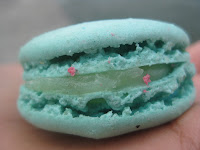
I originally thought that this was a very American idea, given its unnaturally blue hue and vaseline/vick's vapor rub-colored filling.  But tasting it is like eating a baked version of the mint leaf.  Unlike the Girl Scout Thin Mints or the Peppermint Patty, this dessert tastes like real mint.  Like, almost-plucked-right-off-the-plant real.  Or this-isn't-a-dream-like-Inception real.  I guess the only non-real detail about it is the color.  But that's forgiveable.


8Framboise | Raspberry
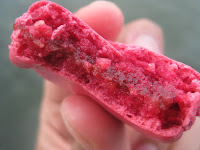
So wonderfully tart and juicy.  Like eating real raspberries.  But warm, like a raspberry tart or cake.  Or toast covered in jam as an after-school snack.  Not temperature-wise-warm, but it just makes you feel warm.  Is that what love is like?  Could this be love?  I berry much think so.

In summary, I would make a terrible food critic because I love everything I can stuff into my mouth...  Yeah, think those dirty thoughts.  But it's incredible to actually taste how well Ladurée captured the taste of each of these macarons.  As mentioned, they have the name for a reason.

The strange thing about these desserts is that you do feel satisfied after eating them, however many you eat.  Almost as if it's an effort to eat another one.  Almost.  With most desserts, there's an unsettling feeling in the stomach and tongue that makes you ask yourself, Could I really have another slice?  But with these macarons...  You leave very satisfied.  And happy.  Like, I was actually smiling while eating them.

They are, of course, mass-produced in one location and sent out to all the other shops in Paris, but I can't help but think that the secret ingredient must be love.  Or preservatives.

I do slightly regret not getting more.  This means I didn't get to try the rose, cherry blossom, chocolat banana, chestnut, blackcurrant violet, or orange blossom ones...  But I guess all I really have to remember was the time I consumed sixteen dollars' worth of desserts in one sitting, and I'll be fine.

At least, until next time.


[Mac-ed Out]

Wednesday, April 18, 2012

Of Complaint

A long rant.  Still in the editing phase, of course, but I felt it was right to release a rough draft as soon as possible.

-||-

To One Ms. She-Who-Shall-Not-Be-Named,

[Because, after all, I actually don't know your name.  But if I did, I cannot say that this letter would be any more pleasant than I'm predicting it to be.

Which won't be very much.]

Let me say this first and foremost: I love me a woman who can lead  knows what she's doing.

Not only does this momentarily remove the pressure of having to stressfully decide what to do for a whole four minutes [an uncomfortably long time for a beginner tango student], it shows me how to properly signal to a partner what to do, and how it feels to be lead.  Suprisingly, not many male students who learn to lead learn to follow in the same class, which - as most teachers believe - makes one a more well-rounded, smarter, and understanding dancer.  A woman who can lead a [reasonably] naive and shy beginner around a milonga will always have a place in my heart and continuously growing list of people who have made this year bearable.

It is at this point in my letter I hope to distinguish the difference between two statements, one of which I have just claimed true, and the other of which I will elucidate:
  1. I love me a woman who can lead knows what she's doing.
  2. I DO NOT love me a woman who has her head so far up some dark crevice of her being to convince herself that she THINKS she can lead knows what she's doing.
I like to reminisce all the way back to one week ago when you first appeared at the milonga.  When I first laid eyes upon you, I chose to ignore the warnings from fellow students about you.  "Oh, watch out for her," one would say, and, "Yikes.  Hide while you can."  Upon asking for further details, all I received in response was, "She is a terrible dancer.  If you're smart, you'll find other partners."

Apparently, I wasn't.

Although I didn't dance with you in class - Mariana [teacher at Tango Queer] chose not to change partners - you found me worthy to dance with later that evening.  Perhaps it was my staring at the empty dance floor that inspired you to dance with me [did I appear as if I was longed to be on the floor?].  Or perhaps it was my sitting alone for two tandas that made you take pity on me.  Most likely, it was my outburst of "SOY SOLO PRINCIPIANTE || "I AM JUST A BEGINNER" followed by my palms keeping you a safe radius away from my body that you found endearing.  My immediate confession to being unworthy of your experience must have been a good enough excuse to still want to dance with me.

Nevertheless, our two or three songs together wasn't even remotely painful.  Heck, you even taught me some rumba during the cortina.  And when I was teased/asked about what it was like to dance with you?

"She wasn't terrible at all," I claimed, DEFENDING YOU, "I don't know what you all were thinking about.  Have you even danced with her?  Give her a chance!"

To this, they just shivered and waved away the thought.

You probably don't read my blog, but as I've expressed before, I like to think that there are two kinds of experienced dancers I've met so far:

  1. The kind who give you hope that you will eventually crack this Da Vinci Code of a social dance.
  2. The kind who make you want to curl up into the fetal position in the middle of the dance floor while everyone seeks mental and physical assistance.  For you, of course.
As much as I love talking crap about someone I hardly know dislike observing and analyzing what I perceive to be someone's eventual downfall room for improvement, I must conclude that you are

THE LATTER KIND.

Considering I enjoy making lists, I present to you several observations in bold and academic commentary in italics that support my conclusion.
  • Repeatedly shaking your head and saying "NO NO NO NO."
    • Lady, do you know how traumatizing this is?  Especially for beginners?  Are you trying to scare people from ever stepping into a milonga again, or are you just unable to control both vocal and neck muscles, resulting in a discouraging response to a horrifying situation?
  • Repeatedly telling your partner that he/she is not moving the correct foot, and that he/she is not moving the foot back far enough.
    • If I'm NOT moving the right foot, it's because my lead IS NOT making me do that.
    • Similarly, If I'm NOT moving it back far enough, it might be because my lead is DRIVING MY SHOULDERS INTO THE GROUND.
  • Repeatedly pressing your fingers to your temple in frustration.
    • Again.  Traumatic.  I understand that as a beginner, it is my duty to learn how to respond correctly, HOWEVER, as an 'experienced' dancer, it's your duty to teach me patiently and not get frustrated in two minutes.
  • Repeatedly telling your partner that he/she is not doing what he/she is supposed to be doing.
    • Like above, if I'm not doing what I'm supposed to be doing, maybe it's because YOU'RE NOT MAKING ME DO IT.
    • Additionally, as the lead, you should be able to SIGNAL to your partner what to do.  As a fellow dancer at Tango Queer once told me, "Think of it as an invitation to let your partner do something.  They might accept it and do what you want, or they might not.  Nevertheless, you continue."
  • Repeatedly telling your partner that he/she is missing and/or forgetting a specific step.
    • I'm not an expert in tango.  [Not yet.]  But what I've come to learn in the past five/six weeks is that regardless of whether or not your partner does a specific step you learned in class, KEEP GOING.  DO NOT drop your arms and tell me to start over with a heavy sigh.  No one is perfect [not me, and ESPECIALLY not you].
    • When doing combinations of different tango moves you learn, you're always going to have to omit a step here and there.  Just because it didn't happen like it did in class DOES NOT MEAN you should stop the dance and start over, or even worse, stop.  Only one species of person does this in the real world: the Diva.
  • Telling your partner that "That's the problem with beginners; they don't know how to walk correctly."
    • Not only is this an insult to your partner, it's an insult to almost everyone in the room.  You're taking a class, and so is everyone else.  Know what that means?  To some degree, WE'RE ALL BEGINNERS.  Yes, that includes you.  Last time I checked, YOU WERE NOT teaching the class.
    • And if it's a problem, help me correct it.  Don't roll your eyes in pain and make your partner do it over and over again without HELPING.
  • Waving the teacher to come over and personally correct your partner.
    • I like to consider this one the lowest of the low moves you can pull in the middle of the class.  Yes, it might be my fault.  But DO NOT call the teacher over and demand her to "Tell him what he's doing wrong."  Not only does this imply that your partner is absolutely wrong, it implies that you are absolutely right.  This, of course, will always lead to both mistakes and humiliation.
    • The teacher might even actually correct YOU and what you are NOT doing.  Like, properly leading your partner for example.  Oh, wait, wasn't that what I was telling you THE ENTIRE TIME?!?!?!
    • I think I'm reasonably modest.  Therefore, when my partner doesn't do something I expected him/her to do in a dance, I take the blame for it.  Please, do us all a favor: Grow up, and STOP BLAMING EVERYONE ELSE.  

If I've learned anything from this experience [not the correct steps for today's class, I can tell you that], it's that I've become much, much, much, more patient with dealing with difficult people situations.  This a life skill [perhaps there'll be a How-To I'll write from this] that few people develop before their eventual death [Exhibit A: YOU].  In some situations, I've learned to take the time to slow everything down and talk through a situation, bit by little bit.  In others, I've learned to gracefully admit defeat, accept losses, and move in a different direction.  Both show an immense amount of maturity and require an equal ammount of patience.

None of which, as I soon learned, I had for you.

Thanks to you, I've revived an old and effective defense mechanism [one that I haven't used since high school...  Cheers, Mom and Dad!]:  The smile and nod.  Often accompanied by music that I hum in the back of my head to drown out your voice, I'll smile as I choose to ignore everything you say, and nod when your lips have stopped moving.

The song I've chosen for you?  This little pick-me-up, specifically chosen when it was played as the cortina when you and I let go of each other and sought new partners.  Eyes glazing over is a bonus, if you can get that to happen next time.

Not that I'm ever hoping for a next time.


Not expecting to hear from you soon,


[Bitchin']

Tuesday, February 14, 2012

Aren't You

-| Masterclass |-

In response to the Ranters' Theatre workshop held two months ago, Jo Stone of Stone/Castro has hosted a series of master classes over the past few weeks to answer the following questions:

Who aren't you?
What defines your identity?
What defines your physical language and performance language?
How far can you get away from it?

Defined as an 'attempt to define your natural physical habits,' Jo's classes have been an attempt to define natural movement tendencies [i.e., keep dancing alone in front of all 25 of us until you run out of things to do, then keep on going until you're paralyzed from having nothing left to do], and push into places of performing that don't sit right with the body.  You know, things that feel wrong.  A space that goes against all of your natural instincts.

-| 3.5 Weeks Ago |-

Philip [referencing a freestyle session with Restless a few days before]:  It's interesting, actually.  You put up this wall - physically - and keep people from interacting with you.  You don't allow yourself to go to their place.  It's like you just want to initiate the relationship with someone, but you don't want to receive it.  At least, that's when you're dancing.  Compared to your real world, where all you want to do is receive and not initiate...  It's just interesting how this part of you is manifesting itself.

Cass [in an email]:  It's just like Bisbee [professor] back at Bowdoin, Magno.  Sometimes art reflects the inverse of your behavior.

-| The List |-

Jo:  Now let's go around and try to describe Josh's movement in as few words as possible.  Feel free to explain why you chose that word, or those words.

chicken
Jo:  Kind of like how a chicken has that outer layer of feathers, your shirt was kind of hiding what you were doing.  Like, you know how those muscles are moving underneath all those feathers but you can't really tell what they're doing?  I wanted to see what your body was doing underneath that shirt...

isolation

panic

warrior
My internal monologue [MIM]:  That... doesn't really go with the last word...  Right?

getting knocked backwards

reaching up to the sky

pharaoh

sacred ritual
Jo:  It just looked like you were doing this for something, someone, up there.  You know, like something was supposed to happen after you finished.

prayer
MIM:  I'm noticing a theme here...

Michael the Great
Had to Wikipedia this one.  Not that it makes much sense, but it has a nice ring to it, don't you think?

ghost
"When you went to the wall, it was like... like... like... like you split into two different people, and you passed through yourself.  I... I... I...  I really felt that, Joshua.  I felt that.  I felt it here [points to chest]."

spirit

stylish

svelte
I had to look this one up in the dictionary:  slender, especially graceful in figure; lithe; suave; blandly urbane.

sexy
MIM:  [Wrings hands in bashfulness.]

love
MIM:  [Continues to wring hands in bashfulness.]

believe in himself
MIM:  [Sweating profusely and finds an interesting mark on the ground to inspect.]

prince
Jo:  Tara, what do you mean by 'prince'?  Like, the singer, or-
Tara:  -the kind to marry.
Jo:  Oh.  Okay.  I'll write that down just so that Josh remembers.  The kind to marry.

self conscious

petite

Justin Bieber
I wasn't the only one to get this comment.  Fortunate or unfortunate, I'll leave that up to you.

karate kids + karate man

fast and slow

dramatic + sudden

James Bond

trapped

angular

Nile River
Matt:  Yeah, he just had this royal theme going on.  But sometimes he was like water, like a river.  So I put two and two together, and it's definitely the Nile.  You know, Egyptian and all that.

sharp

precise

Aztec
Alice:  Yeah, I just wanted to go along with the ancient ethnic royalty theme...

perfectionist

body fix
Zoe:  I just really noticed the parts where it looked like you were trying to 'fix' parts of yourself.  Like trying to replace something that was missing, or something that was broken.

my body reaching out to you

peacock
MIM:  The vainest of the birds.  Am I really coming off like that?

handsome
MIM:  Oh.  I guess so.

thriller
Andrew:  He's like.  Michael Jackson.

pirate

Thomas the Tank Engine in a hip hop competition
MIM:  Compliment?  Insult?

mystery and horror

abandon
Jo:  I just had one more word.  You just remind me of someone who's letting go, letting something inside out, just releasing something.  For someone.

-| Confound |-

For this week, we're supposed to choose two or three words that we really like from our list, think of the opposite of those words, attempt to embody them [our interpretation, of course], and create a solo out of those opposites.  This will result in our 'who aren't you' solo.

One problem:  according to Philip, I naturally move the way I am not in the real world.  If I move the opposite of my movement - supposed to be my 'who aren't you' - won't that actually result in my 'who are you' solo?

Bum bum bummm.


[Not]

Monday, November 21, 2011

Last Monday Night

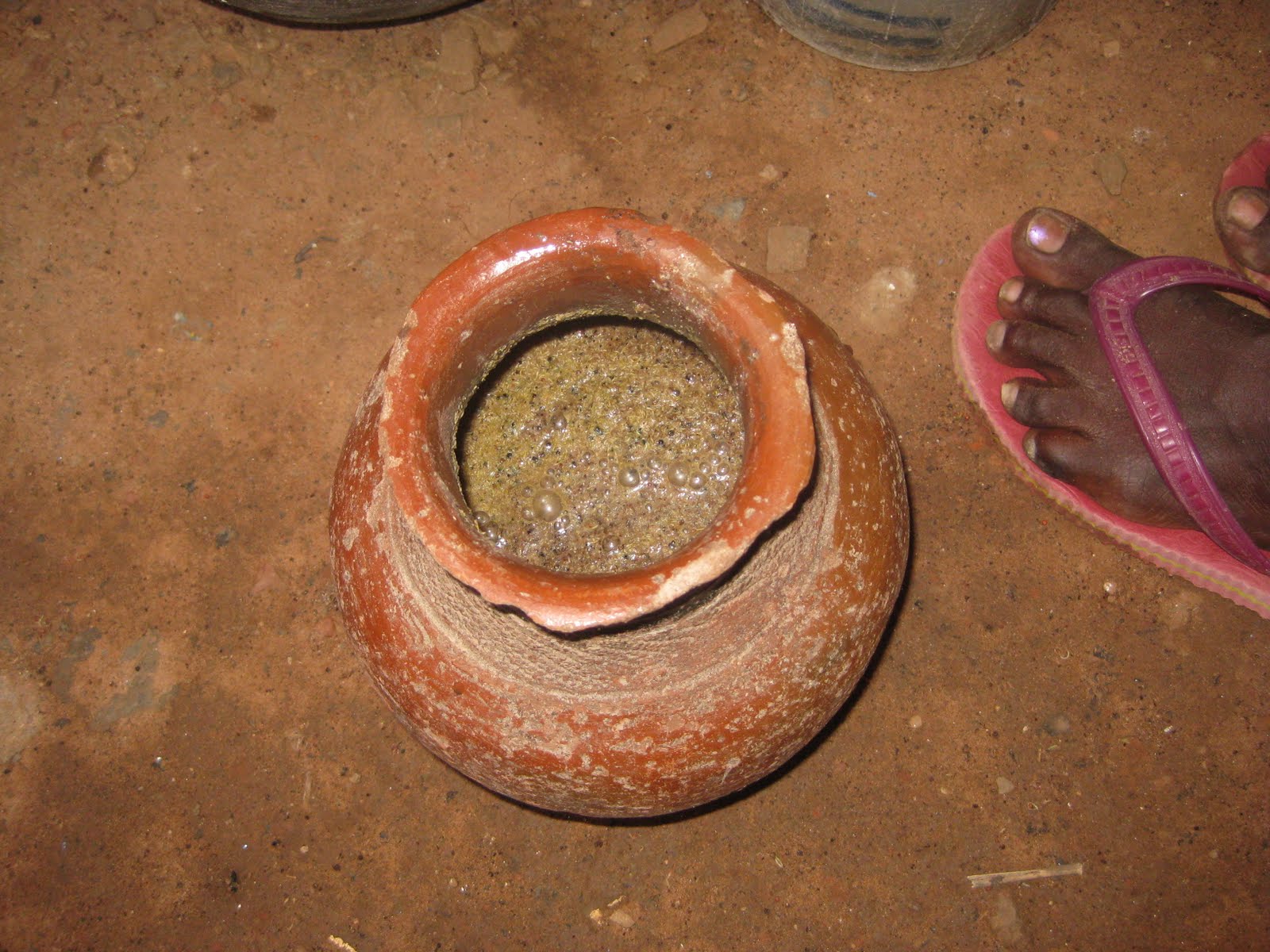
Ma·ru·a [mah-roo-ah] : noun, Ugandan alcoholic beverage from brewed from millet, grains, and yeast.  Mixed with hot water in a clay pot and swallowed through a long wooden straw and a metal filter, marua 'sessions' are commonly had for social gatherings, philosophical rants, discussions about cultural superstitions, and explanations for how to harvest sim sim [sesame] seeds.  Also known as la·coi [lah-choi].


Most experienced drinkers claim that first-time drinkers will not enjoy the taste or appearance or its effects on the stomach.  However, a small population of considerably thin and blue-shirted Filipino drinkers will say that if a wine were to be made of coffee beans instead of grapes, marua would be the final product, that it looks just like finely blended mate, and that no toilet-related problems will follow the initial drinking experience.


Some first time drinkers are observed to be overly excited about partaking in marua that the 'thumbs up' sign is frequently flashed to onlookers.  Luckily, surrogate older brothers [as pictured below] will keep these first timers grounded and acting within a sensible range of reason for the occasion.


At the end of the day, marua comes highly recommended not for its alcoholic content [one will arguably get more of a buzz from one bottle of Nile beer] but for the overall atmosphere it creates, especially that with strangers.  Take proper hesitiation, though, as locals are more than likely to go on rants about why watching cats have sex, having a tree branch break in front of you, and hitting your right leg on paths that go to the left is considered bad luck.


[BuzzLess]

Friday, September 23, 2011

An Analysis

Prompt:  In 500 words or less, describe and analyze a form of movement you have studied in the past month and a half.

-| Kalaripayattu |-

The martial art known as kalaripayattu [kah-lah-ree-py-ah-tew] originated in the Indian state of Kerala, but is practiced worldwide [particularly in Tamil Nadu, Karnataka, Sri Lanka, and Malaysia].  Roughly translated to "fight place," kalaripayattu is usually practiced in a clay room, the ground made of dirt to prevent the oiled practitioners from sliding during training.  It is argued by most kalari teachers to be the oldest, original, and therefore best martial art [1].  Kalaripayattu is recognized for its unique style in strikes, kicks, forms, grappling, weaponry, and healing techniques taught through four stages: meithari, kolthari, ankathari, and verumkai.

Meithari, the initial stage, consists of conditioning sequences focusing on twists, stances, jumps, and turns that increase the coordination, balance, and flexibility of the practicing body.  According to Magazine of Knowledge, in a recent study of world travelers who study kalaripayattu, 100% agree that this stage is unbearably painful when practiced two hours every morning, seven days a week with an instructor who bears an uncanny resemblance to previous karate teachers [2].  “Discipline” is considered the describing word of choice for this stage, as strength, flexibility, balance, and stamina are all practiced at the same time.

Kolthari, the second stage, focuses on the use of wooden weapons, such as the kettukari, the cheruvadi/muchan, and the otta.  Considered the master weapon, the otta is an s-shaped wooden stick that resembles an elephant’s trunk.  Ankathari, the third stage, is practiced only when proficiency with the wooden weapons is reached.  This stage introduces metal weapons, such as the kadhara, the val [sword] and paricha [shield], the kuntham, the trisool, and venmazhu.  The last weapon taught in ankathari is the urumi/chuttuval, the flexible sword, and is taught to only the most skillful students.  After mastering all weapon forms, the practitioner learns to defend themselves bare-handed in verumkai.  A recent poll of shotokan karate students suggest that this order of learning weaponry then bare-handed skills makes somewhat to little sense, but don’t question it considering it’s an incredibly old and proved useful martial art [3].

Legend has it that exceptional warriors can paralyze, disable, or even kill their opponents by only touching the correct vital point [known as a marmam].  These skills, known as marmashastram, are taught only to promising and arguably collected persons, so as to prevent misuse and abuse of the technique.  Accordingly, knowledge of marmam is vital for anyone striving to practice its use in combat; however, it is also used in practicing medicine and massage.  Kalaripayattu teachers usually provide massages with medicinal oils to their students to improve physical flexibility or to treat muscle injuries during practice.  As of September 2011, naïve travelers who chose to practice kalaripayattu have yet to experience the healing techniques.  Sigh.  Oh well [4].

In short, kalaripayattu is an incredibly intensive martial art to study.  Although the experience may be painful and the teacher believes no one should drink water in the 2-3 hours of cardiovascular distress, this form of movement is, in fact, worthwhile [albeit painful] [5].

-| Notes and Sources |-

[1]  According to any kalari teacher you ask.  Don't question it, just accept and move on.  Additionally, these teachers know that kalaripayattu is often applied to dance.  These dancers are thus considered to be noticeably "better" than other performers.

[2]  Gaujho, Mason. "Why Am I Doing This To Myself?" MagKnow September 2011: 4-22.

[3]  Majogo, Shaun. "Literally: Resurfacing Painful Memories." Karate Today, Dance Tomorrow September 2011: 19-89.

[4]  Shoogam, Juan. "Should I Have Proposed A Year of Massage Instead of Dance?  At This Point, Yes." Sore Legs Daily September 2011: 15-27.

[5]  The author[s] wish to note that at the time of this writing, not enough experience or research had been acquire about kalaripayattu.  Clearly, learning and practicing from one master for less than two weeks has not been sufficient enough time to properly learn much, regardless of how ‘fast’ the master claims his student is learning.  This, in turn, results in practices that are faster, longer, more intensive, and therefore more painful than the ones taught to other beginners [6].

[6]  Precaution, however, must be taken in that sufficient sustenance is taken when continuously and regimentally practiced.  According to interviewed teachers of practitioners new to the style, the country, and the vegetarian diet, one may risk falling victim to "losing weight" [7].

[7]  Shoguam, Joan. "Lose Weight?  Move to India!" The Ambitiously Optimistic Omnivore's Dilemma September 2011: 362-436.


[Hugo Jasmano]