Showing posts with label India. Show all posts

Tuesday, August 7, 2012

Going All Along


More than twelve months ago, He set off for a year-long crash course in what He hated to call 'soul searching.'  Thinking that He had lost it to begin with was more than disappointing; it was terrifying.  What else had been unknowingly dropped through the holes in his mid-Western khaki short pockets?

Having an idea of where the winds would take him but not completely sure of what, The Boy remembered boarding the plane that would whisk him far from the land where his closest family and friends resided.  This action, however small it was, would be the first of many times He knew that such a thing as happenstance existed.  Despising his parents for enrolling him into karate classes, being forced to become a puppeteer, being one of two boys who were cut from volleyball tryouts, watching as his parents lost almost everything they dreamed of having, first seeing a dance performance in high school, choosing which schools to apply to and which one to attend, falling in and out of love...  It all carried him to this year, this place, this state of realizing that He

needed

so

much

more

from 

his

life.

Wanting to break His curse, The Beast set out to find what it was He so desperately needed.  True Love's kiss?  Such things only existed in Fairy Tales, and given the circumstances, his story strayed far from that.

... Or not so much.

As a particular french host reminded him on his last night in one of the most romantic cities in the world, "For someone who claims they don't make many friends, there sure were a lot of people to say goodbye to you tonight."  This single phrase would unleash a chain of memories He strung together throughout the year.  He had found so much love in the flowered shrines of India, in the cement huts of Uganda, along the shores of Australia, within the dimly lit milongas of Argentina, and the cobbled streets of France.  Echoes of the most important lessons taught to him resurfaced in a rosy fog, reminding him that

"I never had to choose between passion and profession"

"There is a war in you, and it is coming"

"Wherever you go, there you are"

"You need more presence to lead successfully"

"Being handsome is not enough.  Be great, be beautiful"

The Boy, the Beast, the One that Got Away, Our Hero, now the Prince, had chosen his happy destiny [whatever that would be], that much was clear.  Whatever complicated pathways were ahead of him, He would face them with everything He learned this year, and with the lessons He would keep learning on this journey [according to the fellowship director, "The Watson is never over.  It's just beginning."].

The pieces He found to the jigsaw of his life were now in place, but he knew that there would be so much more to find.  The bigger picture was far from complete, but well on its way to being solved.  He would remember everyone He met during his travels, and how unstuck they seemed to be in life.  Actually, now that he considered it, there were an equal amount of people back home who seemed to be the same.  The unfortunate thing was remembering who did become stuck, so immobile and so scared to find their pieces, to complete their picture.  What they were holding onto, He'd never be sure.

The Prince would hold hold onto this year, these memories, this feeling like none other, trying to remember the last stanza of a poem he found scribbled on a hostel wall:

There once was a man who'd become unstuck in the world -
and he traveled around like a leaf in the wind until he reached the place
where he started out.  His car, his job, his phone, his shoes -
everything was right where he'd left it.
Nothing had changed, and yet he felt excited to have arrived here -
as if this were the place he'd been going all along.

Our Hero had reached the place where He started out, but wouldn't stay there for long.  Not when the next journey was waiting to begin.


[Unstuck in the World]

Sunday, June 24, 2012

One Day


"Joshua," he remembered his mother saying to him, a very, very, long time ago, "One day we'll go to Europe.  You, me, Daddy, and Kikay."  She looked back to the TV screen, where a young cartoon woman began to cry as she reunited with her long lost grandmother.  He remembered not taking his mother seriously, only being interested in finding another peanut butter jellybean somewhere in the bag they bought earlier that afternoon.

"Aye, my god.  Paris...  London...  It's always been my dream to go to all those places before I die.  We'll go.  One day.  Maybe.  When we win the lottery."

Many, many years later, as he pedaled his way past the Arc de Triomphe, past the Louvre, and past la Bastille, this tiny fragment of a memory, however minimally detailed, surfaced to his conscience.  Almost colliding with a parked car, he pulled into an alley and locked his bicycle.

He had fallen in love with the City, that much was obvious.  Throughout his travels, he never regretted any of the places he had gone, but was always asked,

Why did you choose to go there?

His initial answer was simple:  I want to touch each continent before I die.  Upon further consideration, he realized that different reasons brought him to different countries.  India:  where he would experience sensory overload.  Uganda:  where he would learn to appreciate a much more simple life.  Australia:  where he would find how much more he needed to grow.  Argentina:  where he would experience passion, firsthand.  But France?

Where he would live a dream - his or his mother's, that wasn't clear - at the end of a dream year.  Why the rest of his family never made it to Europe, he couldn't exactly understand.  He had made it here without the lottery [although the definition of lottery was now in debate], accomplished before the end of the first quarter of his life.

"Don't worry about your mother," Betty said in Argentina, "If she didn't travel somewhere, she had her own reasons."

As he walked past the patisserie full of macaroons and tartelettes, he couldn't help but think, How fair is it that I got to live her dream before she did?  A tiny pang of guilt tugged at his stomach.  

In Australia, Philip had once expressed hesitation in becoming a parent.  "I think the real challenge in being a parent," he argued, "would be to help my child find happiness.  And if my son or daughter could say one day that they found happiness, I know I'd have done my job."

Later that night, he would take his camera out of his bag and snap a picture of himself with a flower-shaped cone of gelato.  Maybe it was the mix of raspberry and chocolate, or maybe it was the first night that felt like summer, or maybe it was just the good company with whom he had dinner.  Happiness had been sitting there with him so far this year, and he was sure that it wouldn't leave afterwards.


Maybe knowing that would be enough for her.


[Living There TOday]

Wednesday, November 23, 2011

They Call Me Stacy

-| Advice |-

"You know," Charles said, "we pray for you go back home safely.  But we also pray for you to finish your studies, get a very good job, find a wife and have beautiful children.  Your Mama Beatrice and I would be so happy to have grandchildren.  And for Mary Kay to meet her nieces and nephews.  You have a very big journey ahead of you, but as long as you never forget your name and your family, you can never go wrong."

The advice floated in front of Our Hero, flattered at the blessings of strangers he knew for only a couple of months.  But... His name?

-| Multiple IDs |-

Long before his travels, Our Hero had been called by many names:  Magno, Mango, Magneto, Jorgon, Joshaaay, Joshie, Jorsh, Magnus, J-mags, Shmangs, Shmags, Shmagno, Jagno, Shua, Shazaam, and Todd.  Although the more popular ones were variations of the one with which he was born, he had become accustomed to responding to most names using any combination of the "j" "sh" "m" and "g" sounds.  At least, that was how things had rolled in America.

Since traveling, he had collected a fair number of nicknames, coming from social status or even personal jokes. For instance, in India, he had been called Sir by the children at Samarthanam [students are to call all adults Sir or Miss], Joshua Guda by his bharathanatyam teacher [from wearing a towel similar to the sweating working class, guda so prevalent in HSR Layout], and even This Focka by his host [in the most loving way, of course, because of all the shenanigans he had managed to survive].  In Uganda, the Catholic priests had called him Josh, Josh, Josh [head shaking, disbelieving more shenanigans], the cultural dance leader called him omera [brother], the shopkeeper and her husband called him My Son, and her baby daughter - Mary Kay - called him Ankah! [uncle].

-| The Sisters |-

A pair of nuns had once asked Our Hero the meaning of his given name.

Great Lion-Hearted Messenger of God
Magno | Leon | Joshua

"That's one hell of a name to live up to.  Good luck." they muttered.

-| Acholi Culture |-

All Acholi people have two names: the Christian name [the first name] and the Acholi name [the surname, however it is not inherited from the father or mother, but given at birth].  When someone [a foreigner] is taken into an Acholi family, it is the mother and father's duty to give this family member an Acholi name.  Interestingly, if one is given an Acholi name and that person happens to live with someone older of the same Acholi name, it is the younger person's duty to buy a chicken as a gift of respect for the elder.

-| Surrogate Parents |-

"Joshua," Charles said, "your Mama and I have decided on a name for you.  Now, you must know that you are surrounded by so much love.  When you first arrived in her shop, your Mama lovingly invited you to our house.  And you lovingly accepted.  We've gotten to know you, and we pray so much for your safe travels during your studies, and for your safe return home to your real parents.  Mary Kay now sees you as an uncle.  You are loved in this family, and we know that you are loved back home.  You are capable of so much love."

His left eyebrow twitched.  Previous attempts at relationships in high school and college did not support that claim, but Our Hero decided not to mention that.

"So we have decided to name you with the Acholi word for love." Charles continued, and Beatrice's eyebrows furrowed in a way that suggested she was about to cry.  "Loving.  Full of love.  Being loved.  Surrounded by love.  All about love.  You, Joshua, are all about love."

Our Hero nodded at this, and upon hearing his Acholi name, proceeded to hug his Acholi parents, his little sister/niece, and finished his bottle of Coca Cola.  It was funny - he had expected a name that meant of the other land or first born or one who travels, something that he believed would be fitting for this year.  This name, however, was not the first one that would've come to mind.  If you had asked Our Hero before his travels, he would not have used this name to describe himself.  Time away from America had convinced him otherwise.

Our Hero left later that night [after watching The Jungle Book with Mary Kay], knowing this last week in Uganda would be painful, just as much as it was in India.  But he knew Charles was right - armed with the knowledge of his name and prayers of his family, everything was going to be fine.


[Omara]

Wednesday, October 5, 2011

Suspicious

-| 021011 |-

He should have known that traveling from India to Uganda would go awry when the ticket counter looked at the passport, turned to the officer standing nearby, and said, “Magno?  Sir?”  The officer looked at the name, swatted away something in the air, and nodded.

Our Hero looked up from writing his name on the address tag for his baggage and asked if something was wrong.

“No, sir.  Thank you for your passport.”

The rest of check in went as expected; he received the boarding ticket to Dubai, he filled the emigration form, and earned a stamp in his passport for the exit from India.  Before he could pass through security, the x-rays, and metal detecting guards, he wanted to know if he should dispose of the water in his Nalgene.  Walking towards the closest security guard, Our Hero pulled the water bottle out of his bag and waved it in the air.

Like a flock of seagulls on a discarded bagel half on Navy Pier, or a flock of middle aged women at a Josh Groban sighting, a flock of guards descended and encircled Our Hero.  The eldest stepped forward.

“Sir, may I see your ticket and passport?”

Our Hero handed over the passport, which now contained three visa stamps collected from the past five years.

“What is your purpose of visit to India?”

Hoping to simplify his explanation and cut back on the chances of having to apply for a student visa, Our Hero explained that he was traveling, and that he had visited a family friend in Bangalore.

“For study?”

No, not for study.  He had finished university and was taking a break for one year.

“And what did you study in university?”

Neuroscience.

“?”

Our Hero pointed to his skull.

“Is that a study in medicine?”

Sigh.  At it simplest form, yes.  Our Hero did study medicine.

“So you went to Johns Hopkins?”

Our Hero shook his head furiously, incredulous at the thought of attending such a school oriented for solely one topic of study at so early a point in his life.

“Where was your University?”

Maine.

“Your home?”

Chicago.

The questions flowed.  Questions that seemed partially relevant to Our Hero’s trip were asked: Why are you going to Uganda? [To go to countries he had never been before] and What did you do in Jamaica? [built a playground] and What did you do in Ecuador? [the same] and Did you get paid? [no] and Why? [because he enjoyed things like that].  The more questions the security guard asked, the more personal the questions became: Where did you live in Bangalore? [HSR Layout] and Who did you visit there? [family friends] and Where do they live? [in HSR Layout...] and Where did you stay [didn’t he just say HSR Layout?] and Where else did you go during these two months? [New Delhi, Koramangala, Mysore, JP Nagar, Wilson Garden, Peenya] and What does your father do? [bookkeeper at a hardware store, but he just received his nursing degree] and How did you pay for University? [hard work, scholarships, the like] and What is in your check in bag? [clothes, toiletries, chargers, snacks, medicine, gifts, a larger backpacking bag].

Thinking he had done a thorough job of answering the questions, Our Hero looked forward to sitting in the waiting area.

“Mr. Magno,” the security guard continued, and Our Hero’s internal set of eyes rolled, “do you want us to look through your bag?”  The security guard’s eyebrows raised, his body leaned forward, and Our Hero assumed this was his way of asserting his dominance and masculinity.  He preferred his luggage stay intact, but if the guard were to do so, Our Hero had no choice.  Besides, he had nothing to hide, ergo, nothing to be found.  The security guard nodded to one of his four younger henchman, who left around the corner.  Our Hero assumed he was getting the bag.  Major sigh.  This was going to take a while.

Waiting for the younger security guard to return, Our Hero asked if there was a problem.

“Yes, there is.”  The conversation died at that.

Our hero found himself with the five security guards in what he assumed was supposed to be an interrogation room, but the microwave and table salt and pepper shakers and ceramic box of sugar packets made it appear more like a breakroom in Home Depot.  Our Hero felt immediately at home.

The leader asked Our Hero to remove the lock from the bag, and the five guards began to resemble vultures tearing away at a dying zebra; what had taken the entire morning to strategically stuff into the backpack and duffel bag was now splayed across the table in a matter of seconds.

“What is this?”  One guard asked, holding up a black rubber case.  It was a gift a friend had given him earlier that year, which contained adapters to a small, solar-powered charger.

“And this?”  Another guard held up a small grey chunk of plastic.  Our Hero’s father had given him a battery-powered mosquito repellant fan that now in Our Hero’s mind resembled what could have been considered a bomb.  Not that he had ever seen something of the like before.

“What are these tablets for?”  The leader asked, holding up a packet of denture cleaning tablets.  “You wear dentures?”  He asked, and Our Hero explained how he wore retainers, and then proceeded to explain how such retainers were cleaned with the tablets and a cup of water.

A third guard handed the leader a taped pack of detergent soap, leftover from his stay in India.  The Leader removed the tape, pinched some of the powder and sniffed it, and proceeded to have a difficult time resealing the pack.  He gave up, and tossed the opened bag of powder back into the duffel.

The fourth guard looked at the pair of gym shoes and the flip flops, and the leader demonstrated how to probe the inside of the shoes and check beneath the rubber inserts.

Our Hero asked if there was a reason they were searching through his bags.

“We think your travel plans are suspicious," the leader said, grimacing at the thought of traveling from India to Uganda with a one-way ticket.

Was that all?  What a relief.  And here Our Hero thought it was something serious.

The first guard pulled out a plastic bag of clothes, and his hand dove in to search for anything that wasn’t made of cloth.  Our Hero grimaced, and explained how that particular bag of clothes was full of ones that he hadn’t had the chance to wash yet.  The guard slowly removed his hand and pushed the bag aside.

“What is this?”  the third guard asked, holding up a plastic bottle of contact solution.  For his eyes, for his lenses.

“Why do you have so many lenses?”  The second guard asked, holding up a box.  This time, the leader answered in Our Hero’s defense.  “He’s traveling for one year,” he said, rolling his eyes, “of course he has to carry many lenses.”

“You wear SPF 50?”  The third guard asked, holding up a small container of sunblock.  Yes, but only because his mother bought it, thus having no choice in the matter.  “It’s too high.  The number is too big,” the guard said, tossing it back into the bag.

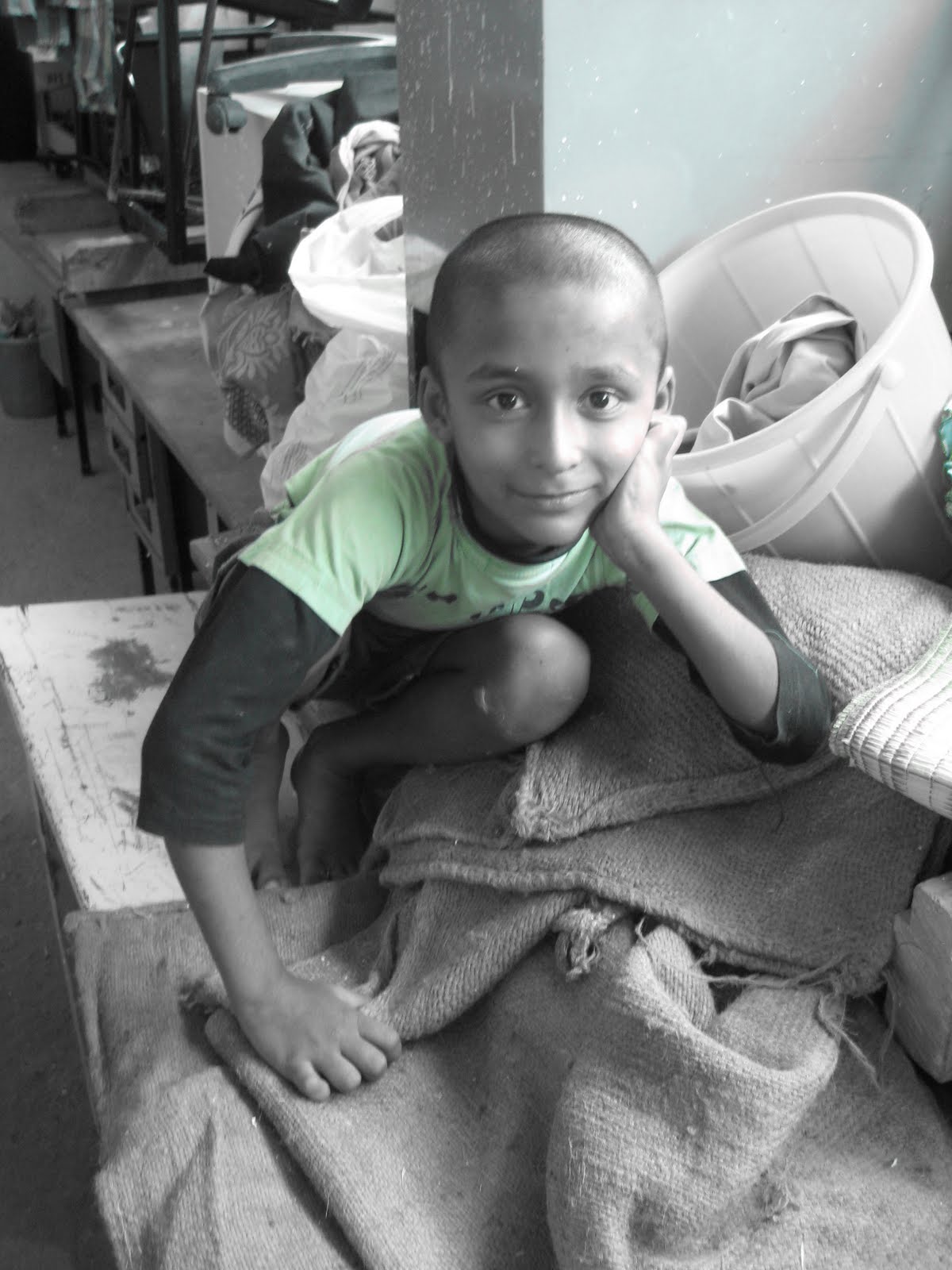
"You found an Indian girlfriend," the leader said, holding up a pink foil-covered gift, onto which a peacock feather and a computer printed image of Jesus was taped.  No, not a girlfriend, but the Little Prince from the children's home whom Our Hero had gotten close, and already terribly missed.

“Okay, well help us put all of these things back into your bag.”  Our Hero attempted to first explain how to repack the bag.  At his frustration, he finished doing it all himself.  Although he believed the search to be finished, the leader asked to look into Our Hero’s carry on bag.

Major, major sigh.

Our Hero raised his eyebrows in amusement while watching the guards figure out that a sweater could compress into its own pocket, that shampoo and soap bottles could come in small sizes, that retainers actually do look like they’re molded from teeth, that someone had the patience to read a book sized like The Count of Monte Cristo, and that Mickey Mouse's [thanks, Sis] shorts were filled with silicon beads, not drugs.  Restuffing this bag with poor care, the leader then asked to look at Our Hero’s wallet [as if he hadn’t shown enough forms of identification to apply for the Russian Tourist Visa].  The leader looked at Our Hero’s credit card, debit card, then driver’s ID.

“I’ve been to Chicago, last year.”  Our Hero deduced that was the leader's attempt at kindness, trying to carry small talk in the middle of the inspection.

Again, Our Hero made the mistake of thinking that the process was complete.  After reorganizing this backpack, he was asked to remove his shoes, and raise his arms to do a pat down.  He watched the insides of his shoes being probed, and then watched as his own waistline was patted down for something that could hide in the space between the belt and the lining of his boxer briefs.

“Okay, well, we’re sorry for the inconvenience,” the guard half apologized with a smile, “You can go now, Mr. Magno.”  Our Hero smiled, and looked at his watch.  It had been almost an hour since he began talking with the guards.

“Safe travels, god bless you, and go to Johns Hopkins, okay?”

Okay, Sir.  He made a mental note to tell his parents that the guard who probed every inch of his possessions for the year gave him valuable life advice and direction.  Our Hero turned to go through the metal detectors, and realized he still didn’t know about whether or not water in his Nalgene was allowed.  He turned to ask the leader.

“Oh, I don’t know.  I don’t know much about security regulations here.”  With that, the man turned on his heels and walked towards the Cafe Coffee Day | Indian Equivalent of Starbucks.

Our Hero hoped this wasn't an omen of things to come in Uganda.


[Suspicious Traveler]

Friday, September 23, 2011

An Analysis

Prompt:  In 500 words or less, describe and analyze a form of movement you have studied in the past month and a half.

-| Kalaripayattu |-

The martial art known as kalaripayattu [kah-lah-ree-py-ah-tew] originated in the Indian state of Kerala, but is practiced worldwide [particularly in Tamil Nadu, Karnataka, Sri Lanka, and Malaysia].  Roughly translated to "fight place," kalaripayattu is usually practiced in a clay room, the ground made of dirt to prevent the oiled practitioners from sliding during training.  It is argued by most kalari teachers to be the oldest, original, and therefore best martial art [1].  Kalaripayattu is recognized for its unique style in strikes, kicks, forms, grappling, weaponry, and healing techniques taught through four stages: meithari, kolthari, ankathari, and verumkai.

Meithari, the initial stage, consists of conditioning sequences focusing on twists, stances, jumps, and turns that increase the coordination, balance, and flexibility of the practicing body.  According to Magazine of Knowledge, in a recent study of world travelers who study kalaripayattu, 100% agree that this stage is unbearably painful when practiced two hours every morning, seven days a week with an instructor who bears an uncanny resemblance to previous karate teachers [2].  “Discipline” is considered the describing word of choice for this stage, as strength, flexibility, balance, and stamina are all practiced at the same time.

Kolthari, the second stage, focuses on the use of wooden weapons, such as the kettukari, the cheruvadi/muchan, and the otta.  Considered the master weapon, the otta is an s-shaped wooden stick that resembles an elephant’s trunk.  Ankathari, the third stage, is practiced only when proficiency with the wooden weapons is reached.  This stage introduces metal weapons, such as the kadhara, the val [sword] and paricha [shield], the kuntham, the trisool, and venmazhu.  The last weapon taught in ankathari is the urumi/chuttuval, the flexible sword, and is taught to only the most skillful students.  After mastering all weapon forms, the practitioner learns to defend themselves bare-handed in verumkai.  A recent poll of shotokan karate students suggest that this order of learning weaponry then bare-handed skills makes somewhat to little sense, but don’t question it considering it’s an incredibly old and proved useful martial art [3].

Legend has it that exceptional warriors can paralyze, disable, or even kill their opponents by only touching the correct vital point [known as a marmam].  These skills, known as marmashastram, are taught only to promising and arguably collected persons, so as to prevent misuse and abuse of the technique.  Accordingly, knowledge of marmam is vital for anyone striving to practice its use in combat; however, it is also used in practicing medicine and massage.  Kalaripayattu teachers usually provide massages with medicinal oils to their students to improve physical flexibility or to treat muscle injuries during practice.  As of September 2011, naïve travelers who chose to practice kalaripayattu have yet to experience the healing techniques.  Sigh.  Oh well [4].

In short, kalaripayattu is an incredibly intensive martial art to study.  Although the experience may be painful and the teacher believes no one should drink water in the 2-3 hours of cardiovascular distress, this form of movement is, in fact, worthwhile [albeit painful] [5].

-| Notes and Sources |-

[1]  According to any kalari teacher you ask.  Don't question it, just accept and move on.  Additionally, these teachers know that kalaripayattu is often applied to dance.  These dancers are thus considered to be noticeably "better" than other performers.

[2]  Gaujho, Mason. "Why Am I Doing This To Myself?" MagKnow September 2011: 4-22.

[3]  Majogo, Shaun. "Literally: Resurfacing Painful Memories." Karate Today, Dance Tomorrow September 2011: 19-89.

[4]  Shoogam, Juan. "Should I Have Proposed A Year of Massage Instead of Dance?  At This Point, Yes." Sore Legs Daily September 2011: 15-27.

[5]  The author[s] wish to note that at the time of this writing, not enough experience or research had been acquire about kalaripayattu.  Clearly, learning and practicing from one master for less than two weeks has not been sufficient enough time to properly learn much, regardless of how ‘fast’ the master claims his student is learning.  This, in turn, results in practices that are faster, longer, more intensive, and therefore more painful than the ones taught to other beginners [6].

[6]  Precaution, however, must be taken in that sufficient sustenance is taken when continuously and regimentally practiced.  According to interviewed teachers of practitioners new to the style, the country, and the vegetarian diet, one may risk falling victim to "losing weight" [7].

[7]  Shoguam, Joan. "Lose Weight?  Move to India!" The Ambitiously Optimistic Omnivore's Dilemma September 2011: 362-436.


[Hugo Jasmano]

Sunday, September 18, 2011

Lifetime Achievement

At the age of 83, he had successfully performed over 5,000 laminectomies.  Although his spine had begun to curve downwards at the base of his neck and his thinning hair had faded to a bone white, the spinal neurosurgeon spoke with the confidence of a thirty-something CEO.

"I want to thank my teachers and my professors," he began, "for without them, my career would not have happened or taken flight.  It is because of them that I was able to practice and learn the skills to perform the laminectomies as successfully as I have been able to do.  I also want to thank my patients for trusting me with their lives, in that they had the confidence to put their lives and illnesses in my hands to attempt to remedy their pains."

Not too shabby, the Boy thought to himself, he's modest.  He didn't let his pride get to his head too much.  He sat in the tenth row, third from stage right, but the Boy had a clear view of the neurosurgeon.  Normally, such a distance from the main attraction would have immediately resulted in the Boy dozing off.  In this case, he inhaled every word the man said.  The neurosurgeon's speech continued, and so did the Boy's thoughts.

This is incredible.  Maybe this is the point where I'm inspired to become a doctor.  There are a bunch of performers here who are also doctors.  This must be a sign of the life I want to have one day, right?

The Boy's internal monologue paused for a moment to listen to the neurosurgeon.

"But most importantly, I want to apologize to my wife and children."  The already quiet audience had ceased to whisper among themselves; the cheery tone of the room had turned sour, tasted melancholic, and  decorated with a small sprig of regret.  "They stood by my side, said it was okay, let me miss very important dances, anniversaries, and sports games just so I could choose my profession over them.  How many times did I neglect them just so I could go to work?"

The question hung in the air like a corpse on the gallows.  Accordingly, the Boy held his breath and wrinkled his nose.

On second thought...

-| two weeks ago |-

"This Friday, there's going to be a convention for international spinal surgeons and I've been invited to perform a traditional dance,"  Raksha said, finishing practice, "Actually, there are going to be other performers too."

He breathes heavily, the cramp in his thighs twisting tighter and tighter from the stomps, squats, jumps, and spins he's repeated in the past hour and a half.  Dancing about the joys of nature and honoring Lord Shiva takes a surprisingly high toll on the stringy body of our hero.

"In order to perform in this convention, you have to be a practicing doctor and a performing artist."

His ears itch at the mention of this detail, and he stares at the living room adorned with gods of clay or precious metal, candid photographs of the dancer, and her incredibly melancholic cat, Shibu.  Raksha continues.

"There's going to be a spinal surgeon who plays the veena [an instrument used by the goddess of knowledge Saraswati], a breast cancer surgeon who also is a singer, and a pediatrician who plays the violin."

Our hero asks two things: the first, if it's wrong to desperately want to become a doctor/performer after learning about this mysterious super-breed of human; and the second, what the hell it is he's going to do with his life.  Again, Raksha doesn't miss a beat [pun].

"You know what you're going to do already.  You're just a little confused now because all of these options keep appearing.  You'll realize it when the time comes."

Here's to hoping.


[TB/OH]

Thursday, September 15, 2011

City Goes To Bed

-| ten months ago |-

During the application process, my fellowship interviewer asked me if I had any questions for him.  Not wanting to be the "Oh, you've already answered all my questions for me, sir." kind of interviewee, I pulled the first [admittedly unoriginal] question that came to my head:

"This year is supposed to change your life, so what was the most important thing you realized?"

Instead of answering in the proverbial "The world is smaller than you think," or "You never know yourself until you lose yourself," my interviewer deadpanned and said flatly,

"I just realized how alone I was."

-| one and a half months ago |-

At this point in my year, I'd like to take a moment to address something pertaining to this memory [and the chain of memories following it]: thus far, there was only ONE time I recognized this feeling, and it occurred on the second night in India [the first was spent waiting in paranoia until morning in Bangalore International Airport].  I laid awake in the plastic-covered bed provided by Samarthanam, my left ear under attack from the mosquito hovering around it, my eyes still bloodshot from jet lag.  At three o'clock in the morning, a malevolently tiny whisper asked, What are you doing here?

I swatted away the question, mumbled something about dance and community service, and tried closing my eyes.

You are SO alone.  The voice returned, riding on the back of the mosquito.  The only people who ever cared about you are half a world away!  The voice curled itself into a ball the size and texture of a marble, and settled itself at the base of my throat.  [Call it doubt, call it nerves, but the following morning I called it ignorance, given the voice disregarded the fact that some fellow schoolmates were not only in India, but in Bangalore.]

The first night and you're already a wreck.  The tiny voice reached from my throat and squeezed from behind my eyes, starting a miserably wet burning sensation.  I gripped the tiny Mickey Mouse [thanks for the going away gift, Sis] and bit my lip.  Maybe if I waited long enough, the voice would get tired retire for the night.

You really think you can do this for a year?

"No."

-| three and a half months ago |-

He, a freshman-to-be-proctor, sat on the floor of my bedroom, waiting for me to finish stuffing a cardboard box with posters, neuroscience books, whiskey glasses, and a silk smoking jacket I knew I wouldn't need after graduation.  It all belonged to him now.  He stared, amused, then laughed as I struggled to close the flaps on the box.  The conversation had run dry, and acknowledging this, he asked me if I was pumped for the next year.

"I think I'm more scared, dude."

He raised both eyebrows and scoffed.  "Why?"

"I'm going to be alone for a year.  And I know this is what I signed up for; actually, I think it's why I applied.  So it's going to be good for me, right?  I get what I want?  To be alone?"

As with so many people in my life, he didn't miss a beat.  "Look at you.  Look at who you've become here at Bowdoin.  You can't be alone.  It's not possible."

-| one month ago |-

Closing the door to our room, I looked to my roommates: one from Taiwan, one from Zimbabwe, and the newest one from Italy.  The United Nations.

"Friends," I boomed in my American accent, "shall we head out to dinner?"

-| two months ago |-

Bumper, AKA The Roommate From College, sat next to me in an empty Fuddrucker's.  I swallowed the elk burger, having a hard time determining the difference between this and a regular beef burger.  For the umpteenth time that summer, I answered the question: Are you ready for the next year?

"You're going to love it," he said, running over my concern and hesitation with a steamroller, "You know it."

-| now |-

I kid you not; it's raining [ah, symbolism].  No, not raining, but pouring.  The last roommate [Taiwan] is filling his suitcase, checking his flight itinerary, and for once I can hear my echo in our bedroom [Zimbabwe and Italy left in the last two weeks].  We're about to ceremoniously buy him his last cup of [5 rupee | 11 cent] Indian coffee, and it doesn't feel like anything will change.  Please don't misinterpret this. I think he's a great guy, and has been here to guide me around the city since my arrival.  My farewell has been and will be the same:

"Until we meet again."

Maybe it's because I've said as equally meaningful hellos and goodbyes in shorter periods of time, or maybe the hardest one I've had to do so far happened only four months ago, or maybe it's because I believe I'll see each of them again, but I've learned to not say goodbye.  Not only do I consider this a cynical way to end a brief meeting of friends, but also just too prophetic.  Of course you'll never know if you ever meet again.

I'll be honest; that voice is starting to whisper again, only this time, I won't have roommates to swat it away.  Feeling like I'm the only one in the room will be for real.  As mentioned, the fellowship highly stresses that we should fly solo, not get used to traveling with other wanderlusts, to live independently but share experiences with those who cross my path.  I can't tell whether or not having roommates has fit this criteria or cheated it, but I do know that they've made this first sixth of my year bearable [there's always someone to talk to at the end of a long and sweaty day] and at the least, entertaining [insert shenanigan concerning misinterpretation of English words] and educational [I've become proficient in the art of finding at least 3 different ways of saying something, so the accent barrier doesn't prevent us from having sensible conversations].  For that, I'm grateful to them.

Do I know what it's like to be alone yet?  I can't say whether it's possible on a trip like this, or ever in someone's lifetime.  You will always find someone, and that someone leads to someone else, and in the end it becomes one entertaining chain of meeting a person through another.  Some might say I robbed myself out of the solo experience by living with three other roommates [technically, the most time we spent together was sleeping no more than three feet from each other].  To these, I would say my roommates came and helped me realize something very important during my year, and thus couldn't have been a detrimental aspect of this trip.

Although I may try to be alone, it doesn't mean I will be.


[On My Own?]

Monday, September 12, 2011

Riddle of Mal

"What are you taking out of this world?" Bala asked.

The Boy scooped another spoonful of vada and samba into his mouth, pondered the question, and decided not to answer.  The two had spent the last hour talking about Tomas, choosing dance over some other profession, and religion versus spirituality.  He, Bala, a thirty-something year old man and fellow kalaripayattu student, sat across from the Boy and twiddled his half-empty teacup.

"What were you born with?  Riches?  A silver spoon?  Your parents?  Your siblings?  Nothing, really.  Nothing you can keep forever.  And that's what you leave with."

The Boy considered this and pointed out the grim nature of Bala's self-answered question.

"That's what life is all about, man.  We worry too much about how much money we make and what we can afford and what other people do or don't have.  Money comes and goes.  In the end, you can't ever really say you owned something, because really, you never did."  A pause to drain his teacup.  "Life's too short to worry about things that won't stay yours forever.  But your experiences?  Your memories?  They can't be taken away."

This much made sense.

"Do something with your life.  Have experiences.  Learn about the world.  You?  You're doing that already, you're on the right path."

The Boy swallowed some coffee.

"I believe that life is like a train ride you've already embarked upon, and you don't know most of the details.  Someone bought you a ticket, and that destination is coming.  Sure, you can run around the train, worry about the destination and when it will arrive.  But running around won't make that destination come any sooner or later.  Or, you can walk around the train, look out the window, talk to other people, and learn from them.  Share your stories, listen to theirs, and continue.  Make the ride worth it."


[Jagno]

Friday, September 9, 2011

Trust


The Boy had trust issues long before he had set out on his Journey; several times in his life, he’d find himself trusting too much [at the tender age of 10, the Boy prepared lemonade while Alex Fan, the neighborhood card collector and eventual delinquent quietly pocketed a holographic Clefable card from the Boy’s collection], or too little [although the weatherman claimed the tornado was traveling in the opposite direction of his home, the five year old Boy packed his most prized possessions – six stuffed animals, a K’nex set, the Goosebumps series, and a videocassette of “The Nightmare Before Christmas” – into plastic grocery bags].  Enforced by years of endless warnings about the dangers of Spring Break, alcohol, strangers, and middle eastern conflict from Barbara Walters and Diane Sawyer on shows such as 20/20 and Dateline, his parents told him over and over and over again:

“DON’T TRUST ANYONE.”

The Boy, as with most children his age, completely disregarded listening to this piece of advice and continued to frolic in the neighborhood cul-de-sac and read books about young adults who traveled through time, space, and dimensions with the help of witches, aliens, trolls, and the homeless.

By the time he had set out on his Journey, the Boy had yet to build a mental prototype of a person he could or could not trust.  Stories such as Roald Dahl's "The Landlady" had prevented him from building such prototypes, resulting in the inability to appropriately trust someone upon first meeting them [hadn't he heard somewhere that one 'accurately' judges a person in first five seconds?].  Regardless of such stories, the Boy had began a Journey, only to find himself caught between reality and [for the most part] irrational fiction, a predicament he found entertainingly iconic and prevalent in his life.

Take, for example, his fleeting encounter with Tapan.

The Boy had just left the five star hotel in Richmond Circle of Bangalore, a good 10 or so kilometers from HSR Layout, his current homestay.  The night had been a long one: the speakers at International Spinal Surgeon's Convention had questionable public speaking skills, lesser questionable English speaking skills, and even lesser questionable neuro spinal surgery skills.  After listening to one doctor's lifetime achievements after another, the Boy began to feel more confused and conflicted than ever before.  Was this his inspirational moment when he decided to become a doctor and do honest and noble work?  Or was this his warning of what fifty, sixty years of endless commitment to profession did to the mind, body, and personal relationships?

As he stood at the bus station, he couldn't help but notice that no buses had arrived, or were arriving.  He prodded the Young Man next to him, and asked when the next bus would come.

"Buses closed.  10:30.  Open at 5 am."  The Boy looked at his watch.  A quarter to eleven and the only reasonably-priced way to get back home was closed for another seven and a half hours.  He grimaced, waved for an auto to come, and asked how much from here to HSR Layout.

"300 rupees."  The Boy raised an eyebrow, then a palm to the driver's face, and walked away.  That was more than three times the actual cost.  Although it was late at night and his options for transportation were diminishing, he was still on a budget.  The driver waved the boy back, and asked how much the Boy had.  Well aware this was a trick, the Boy patted his pockets and said that he only had 100 rupees.

"I'll bring you to Silk Board," the driver said, choosing a popular bus/auto stop about three kilometers away from HSR Layout, "for 200."  Maybe he should start walking home.  He saw the same Young Man from before speak with the driver, shaking his head.  The Boy heard the Young Man say "Silk Board" and general disagreement continued.  As the auto drove away, The Boy prodded the Young Man again, asking if he was going to Silk Board.  The Young Man said yes, and before he processed what he was saying, The Boy asked if they could split an auto there.

"Sure," the Young Man said without hesitation, "What difference does it make to me?"

In a matter of minutes, they had found an auto who was willing to drive them both for a total of 60 rupees.  The Boy's eyes shifted back and forth between the road passing by and the Young Man sitting cross-legged next to him, one arm perched around the Boy's shoulder.  The Boy could hear his mother, half a world away, screaming at him not to get into the auto.

This is what the Devil looks like, the Boy thought, before he strikes a deal with his customer.

"You're from?"  The Young Man asked.  The Boy explained he was from America, here to volunteer on a scholarship.  The Young Man looked impressed.

"I thought you were from Northern India.  You know, with the fair skin."  Flattery.  Such was the bait of the Devil.  The Young Man continued, "You live where?"  The boy said HSR Layout, and restrained himself from saying more.  The need to keep conversation alive was battling with the need to give away too much information.  The Young Man said he lived near Silk Board, and he worked in Richmond Circle.

Until 10:30 at night?  The Boy wondered.

"You speak Hindi?"  The Boy answered no, only a little Kannada, just enough to convince some autos to drive him for cheaper prices during the day.  Apparently not.  "You should learn," the Young Man said, "More useful."  The Boy nodded in agreement, and searched for something else to say.

"You should be careful next time," the Young Man said, "This is a dangerous place for foreigners after the buses close."  The Boy's heart stopped.  "Especially where you're going.  Just because you look like you're from Northern India and you speak a little Kannada doesn't mean robbers won't target you.  Robbers here don't have any discrimination between foreigners and natives."  The Boy patted his pockets discreetly, and felt some relief when he found his wallet, keys, and mobile phone still there.

"You never know who will get into an auto with you."  The Young Man said.  The Boy froze for a moment, then turned his hands into fists.  If the chloroform rag was going to be pulled out, the Boy would go down fighting.

The auto stopped and both travelers stepped out.  After paying the fee, the Young Man sprinted down the road.  "COME."  He said, and the Boy followed.

He's probably going to lure you into his house, the Boy thought, and imagined what it would be like to be tied down to a chair or chained to a wall.  What are you doing?

The Young Man stopped, and held an arm out.  "Here."  The Boy looked in the direction of the hand, and was surprised to see a familiar bus - the very last one for the night - just about to depart.  "You take this to HSR Layout.  You know the way?"  The Boy was floored.  Why didn't the Young Man offer a drink at his place?  Or a ride in his car?  Where was the offer to provide safer transportation at this hour?

"My name is Tapan."  The Young Man said, offering his hand to the Boy.  The boy shook it, and offered his name in return.  He thanked Tapan just as the bus driver returned to the steering wheel.  He wanted to say more, maybe a 'good luck' or 'be safe,' something to indicate that trusting the Young Man had been a blessing, but before he could, the bus doors snapped shut.

Tapan had already run away.


[the Boy]

Tuesday, September 6, 2011

You See, For Me

It is often common sense to follow one rule when you find yourself in the middle of a wedding, or in the middle of a public speech, or in the middle of a crowd of strangers, or in the middle of a dissociative identity disorder attack:

Never say anything bad about the people around you.  You never know who's listening.

That is, of course, if you mention names.  With names come identity, with identity comes blame, and with blame comes unfortunate publicity.  Regardless, I strongly believe that [however little] readers of this blog learn something from my entries, I will attempt to hold back no details from the [mélange of] stories, anecdotes, and transcribed dialogue involving one. other. person.
Except the name, of course.  For simplicity's sake, I'll refer to him as "Tomas."  Enjoy.
.
-| one |-

I met Tomas under what most people would consider "normal circumstances": another volunteer at Samarthanam, Tomas arrived about month ago to study with the blind sports manager in hopes of managing his own blind sports bar [which, as I recall, sounded suspiciously like a normal sports bar but with headphones so the visually impaired could also enjoy the radios and televisions].  Someone who has ever fallen madly in love, then out of it, however, knows that there are no such things as "normal circumstances."  Interestingly enough, Tomas is also blind, so one would assume that his motivations for coming to India were incredibly high, and the fact that he had spent the previous seven months in Kerala would imply that his tolerance for Indian culture was somewhere between "This is India, get used to it" and "I might as well have been born here."

Speaking with him, I quickly learned that he loved talking about his home country - who didn't? - and that he loved talking about how friends/family/strangers said that his inspirational story should be turned into a movie.  In short, he wrote about the world in first-person.  Nothing out of the ordinary.

-| two |-

Everyone in the house had been stricken with one illness or another; after all, August was monsoon season.  But the blind sports manager and other volunteers should have known something was wrong when Tomas' flu lasted more than four weeks, six trips to six different doctors, and a drastic reduction in the "foreign food" he was eating [at one point, all he ate was store-bought white bread, cheese squares, and 7-up, which he called juice].  On several occasions, I offered to bring him food from the nearby children's home, which always made me feel better, and each offer produced the same response.

"You see, for me, spicy food isn't good for getting over a sickness."

A month had passed, and the farthest Tomas had traveled from his host's house was across the street [with company] to the convenience store to replenish his food store.  Again, I offered to bring back food from the children's home to add some variety in his diet.

"No."  He said flatly, "I don't like it."  I didn't offer again.

-| three |-

Josh [entering the office room]:  Friends!  What's up?
Tomas:  Josh, I was telling Alessio here about my thoughts about marathons.
Josh:  Oh?
Tomas:  I don't like the definition.
Josh:  ... I'm not sure I follow.  Isn't the definition of a marathon so-many-odd number of miles/kilometers, and it's named after the Greek guy Marathon who ran back to his home village after his kingdom won some war?  [History has never been a strong point.  For more on the topic: Marathon]
Tomas:  You see, for me, that's a nice story.  But I don't believe it.
Josh:  What?  The definition of marathon 42.195 kilometers, or 26 miles and 385 yards.  At least, that's what it says on Wikipedia.
Tomas:  I don't trust it.
Josh:  So how would you want to define it?
Tomas:  You see, for me, I would define it as "a long distance run by a person."
Josh:  But a long distance could be different for anyone.  The reason a definition exists is so that you can set a certain bar for everyone, not just so anyone can give their own meaning to it.
Tomas:  So what would you call a race that you ran that's 43 kilometers?  Or 44?  Or 100?
Josh:  A long f*cking distance I would never decide to run.
[Tomas laughs.]
Josh:  Isn't that what an ultra-marathon is called?  Alessio, you're a runner, right?
Alessio [hesitant to enter the debate]:  ... Yes.
Josh:  How long is a marathon?
Alessio:  It's about 42 kilometers.
Tomas:  I don't like it.
Josh:  How can you deny the definition that's given by a [mostly] accurate website and a runner?
Tomas:  I just don't think it's true.
Josh:  But that's like denying the definition of the speed of light.  You can't just generalize it as "very fast."

-| four |-

As an act of friendship and an offering of peace, I regularly lead Tomas to a nearby supermarket.  Everyone has to eat something, after all.  Today, instead of buying water ["I don't trust the bottled water in the house, or the boiled water at the school."], crackers ["I have to be ready for when no one feeds me."], apples ["I need to strengthen my immune system."], and several packs of mentos [no explanation], Tomas wanted toiletries.  I brought him over to the lotion aisle.

"How much is it?"  He asked, and I explained that it depended on the size and brand of the bottle.  We proceeded to spend the next ten minutes opening bottles and smelling the contents inside.  He then asked to go to the mouthwashes.

"How much is it?"  He asked again, and I repeated that the size and brand of the bottle determined the price.  Each of the bottles were sealed in a plastic wrapper, so no smelling was allowed.  At his request, I began to read the brand names and description of each kind.  After choosing a bottle of red "spicy and herbal" mouthwash, he asked to go to the spray deodorants.

"How much is it?"  He asked a third time, and I dug my nails into my palm as I mentioned that size and brand were important factors in a manufacturer's choice in assigning a price to their product.  I noticed and mentioned the "No Testing" label underneath the row of aluminum cans.  Tomas asked which brands were available [about 10 or so], what were the colors of the cans [from red to gold], and what were the names of each smell [anything from 'Suave' to 'Street Sexy' to 'Pirates of the Caribbean'].  After choosing one, he opened the canister and sprayed a bit on his arm.

"No Testing." A store cashier materialized from behind the shampoos, and walked away.  Tomas chose another canister, and sprayed again on his arm.  I mentioned the cashier's warning, and Tomas turned to me and defended his case.

"You see, for me," he began, as usual, "I'm blind.  And I want to know what I'm buying.  So I will spray."  I imagined myself explaining that even visually-abled people couldn't smell the spray through the aluminum.  I decided against it.

-| five |-

Josh [entering the children home's office with an adult]:  Tomas, how long have you been waiting here?
Tomas:  For forty or fifty minutes.  Are you eating dinner now?
Josh:  Um, the children's home started already.  A while ago.  You could've started without me, you should've just asked one of the grown ups here to walk you to the kitchen.
[The adult points at Tomas' feet.]
Josh:  Oh, Tomas, they want you to take off your shoes before you enter the school.
Tomas:  You see, for me, I think I'm coming down with a cold.
Josh [wanting to desperately call Tomas a hypochondriac]:  Oh?
Tomas:  And you see, for me, you get a cold from walking on cold floors.  You absorb the cold.
Josh:  I'm not sure that's how it works...  But no one here wears shoes indoors.  Sorry dude.
Tomas [vocalizing frustration]:  AAAAAARGGGGGHHHH.  They are making it SO HARD to live here.
Josh [mumbling to himself]:  I'm not sure it's them who's making it hard...
[The adult points at Tomas' feet again.]
Josh:  I think they still want you to take off your shoes, Tomas.
Tomas:  But I don't want to.
Josh:  Why not?
Tomas:  My shoes will get stolen.
Josh:  By who?  I leave my shoes at the door all the time.  The other volunteers do too.  And the teachers.  Everyone.
Tomas:  But they're MY shoes.  I don't want them stolen.
Josh:  They won't get stolen, Tomas.  No one's shoes have gotten stolen.  Besides, they're just shoes.
Tomas:  JUST shoes?
Josh:  Yeah, man.
Tomas:  And what happens if my shoes get stolen.
Josh:  Buy some more?  India's kind of the giving tree when it comes to things like shoes...  I don't think they'd cost too much.
Tomas:  But they're MY shoes.
Josh:  I guess you're going to have to choose between not eating and not getting a cold, then.
Tomas releases another grumble of anguish, and removes his shoes.

-| six |-

Tomas had asked a friend of mine to lock the door of the office in which we were sitting.  This would be a problem, since other volunteers were constantly walking in and out of the office.  We pointed out this problem, but Tomas persisted.

"You see, for me, as a blind person, I don't know who will walk into the room and steal my things." Tomas was on the defense again.  We assured him that wouldn't happen, since there would be at least one other intern in the room with him at all times.  Again, he said to lock the door.  We made the mistake of asking why.

"I DON'T TRUST INDIANS."  He said, flatly.

Wrong country to travel to, buddy.

-| seven |-

I should have prefaced this entry with a warning:  I have no intentions on painting the disabled in a negative light.  Contrary to the vignettes listed above, I've actually met several visually-handicapped, hearing-impaired, and club-footed men and women.  Regardless of these hardships, however, they've shown me how they take on the world and challenge the people who question their abilities to accomplish even the most mundane of tasks.  In short, these people are an absolute delight and inspiration to anyone who has the patience to hear their story.  Although I'd love to take the time to write down each and every story I've heard from these men and women [who knows - maybe one day I will], I thought Tomas' was particularly interesting.  I present to you a man who wishes to change how the world - or, at least, his home country - sees the blind, and has the fantastic opportunity learn how to do so in a country that is MILES away from home.  And yet, he refuses to look past his own excuses, insecurities, fears, and prejudices of this land of plenty, resulting in getting himself stuck between a rock and a very dark place.  From what I've learned so far, India will teach you amazing things; some in topics that you hoped for, but mostly in ones you never even considered.  If you merely opened your eyes to it [seriously, no pun], allow it all to become a learning experience, you'll find happiness and wisdom in the most frustrating of deodorant-spray-lined aisles of a supermarket.

In the fourth chapter of the Bhagavad Gita, Krishna explains to Arjuna about the importance of "The Path of Wisdom."  I thought this particular excerpt was a good way to finish my entry on Tomas:

But the ignorant man, and he who has no faith, and the skeptic are lost.  
Neither in this world nor elsewhere is there any happiness in store for him who always doubts.

Ah, symbolism.


[Mags]

Thursday, September 1, 2011

Attempts At Being Artsy

OR [ Photos with References as Titles ]

OR [ Sixteen Sweet Shots ]

OR [ Josh Discovers the "Color Highlight" Option on His Camera ]

-| Save Spot |-

-| Kong |-

-| The Bad Color |-

-| Californication |-

-| Le Petit |-

-| White-Wash |-

-| No Evil |-

-| Hero |-

-| Jasmine |-

-| Julia & Julia |-

-| Orpheus |-

-| Krispy |-

-| Who Stole the Tarts? |-

-| Auntie Em |-

-| Like Father, |-

-| He Who Smelt It |-

Happy Ganesha Festival, India.


[ Os ]

Monday, August 29, 2011

Billet-Doux


Dear Life,

I'll start off by being blunt and straightforward [something I've avoided being for a very, very long time]: I've fallen madly in love with You.  Not in an "Obsessed" kind of way, but more of a "When Harry Met Sally" kind of way.  Please don't worry.

As I write to You from my balcony, eating custard apple, drinking coffee, and waiting for You to get ready for another day, I can't help but think of where we were half a year ago.  Stuck.  Stuck in a very black and white world, and preparing ourselves to stay stuck, anchored, and running around in circles.  As limiting as the word can describe the feeling, we were unhappy.  With each other, with the lack of direction we had, and with [what I considered] the lack of things we accomplished in our 22 years of knowing each other.

But all of that changed, no?  We ran away together with plans of seeing the world, not really knowing what to find except everything that we couldn't at home.  Yes, the first night in India scared the crap out of us; the only thing we had [prepare for the cliche] was each other.  And let's be honest: can you trust someone you don't like?

Now look at us!  The colors, the smells, the sounds, and the tastes of just one country have made you my best friend, my most loyal companion, and my trusted sidekick.  We've eaten more food than we thought we'd enjoy, and gotten more lost navigating the public transportation system than our legs wanted to handle.  You pushed me to argue with the auto drivers, foolishly dance like an American at weddings, and speak as much broken kannada as I possibly can with strangers.  You convinced me to wake up at 5 am to catch a 6 o'clock bus so I could practice kalaripayattu at 7 am on an apartment rooftop with a five time national kalari winner and professional dancer.  Oh, and we've talked about our other teacher/dancer/dentist who's been nothing but another mother and inspiration to us.  And how many people from the U.S. can say they've read and enjoyed the Bhagavad Gita in India?

Let's not forget the mysterious skin condition that didn't even phase our plans of practicing dance or martial arts or going out to see more of India, regardless of the number of painful blisters.  [ More of that later. ]  Or the mosquitoes/foreign tick-looking bugs that find their way into your net-covered bed.  Or that any bus/auto/vendor that doesn't "have change" for your money will assume we're fine without receiving the difference.  Or how that bus will sometimes kick us out before arriving at our stop, forcing us to walk for an extra 45 minutes home.

We've come a very far way, love, and we still have a very long way to go.

I'm excited knowing that I have this next year to spend with You, and many years after that in whatever I choose to do.  We'll keep running around until we're tired, and then probably run a little more.  I love spending time with You, which is why I don't want to waste it checking Facebook or Skype or Youtube or Xanga or Twitter or [insert other social media website here] - essentially everything that I could be doing in the U.S.  I think of everything I can/could/would be doing back home [staying stuck], and I'm glad that I got away.  I'm the one that got away, who escaped the waiting place, who refused to run in circles, who left home to search for something bigger, who wanted to fly rather than walk.  I left because I knew I could.  I traveled to keep changing and growing because where I was at the end of college wasn't enough for me.

And You were always there.

In the month that I've traveled with You, I've realized a very important thing: I'm [as limiting as the word can describe the feeling] happy.  And regardless of how stressful You can be, I realize that I'm consistently happy.  Another thing I haven't been in a very, very long time.  I don't feel bigger or smaller, just like my skin fits better.  Not perfectly [still far from that], but better.  Thank You, Love You.

Yours,

[The One That Got Away]


Friday, August 19, 2011

You Raksha My World

There are few times in one's life when someone so ground-shakingly inspiring comes along and whisks you away on her electric scooter through the streets of Jayanagar, Bangalore.  This someone, when you meet her, may arrive at the most inconvenient time, say two weeks before you [think you will] leave for another state, and promise classes in traditional dance choreographed for each god in the Hindu religion.  Sometimes, she may arrive at the most opportune moment, two weeks after you discover the reason you came to India [Sunadha] will not dance on the same continent for the next two months.

Today, our young hero meets this woman, Raksha [ meaning "protector" - ah, the symbolism ] at the most opportunely inconvenient time during his journey.

Raksha carries two business cards: one in plain white, displaying her contact information as a "Dental Surgeon" and the second in black and sepia pictures, displaying a woman elegantly dressed in traditional Bharata Natyam clothing, posed in a series of candid performance shots.  This second card bears the title "Artist & Consultant Dental Surgeon."

She NEVER had to make a choice between performing and becoming a doctor.

"As with most Indian parents, mine wanted me to become a doctor.  So I did.  But unlike most Indian parents, mine wanted me to keep my passions alive.  They wanted me to stay in touch with art; art shows how we live, how we feel, how we think, and everything that cannot really be accomplished by our jobs."

Her mom also sits in the living room, and hands our hero a cup of coffee.  "I wanted my daughter to be able to do everything."

-||-

Raksha has finished discussing the practice plans for the week with a group of women in their home.  Our hero sits next to her, drinking guava juice and smiling politely, debating about whether or not he should try speaking in Kannada.  Instead, he asks about who she usually teaches.

"I teach anyone who wants me to.  These women, who are almost fifty, have never danced before.  But they want to show some people who are coming from New Zealand at an upcoming festival, so I'll try to teach them something before that.  And there's this dance with sticks, janapada, that I was afraid to teach children because there's a lot of smacking - you're always worried they'll hit each other instead of sticks.  And with the handicapped students at Samarthanam?  They learn by feeling and touching.  You're always surprised at what people are capable of doing."

-||-

The couple are hurtling through JP Nagar on Raksha's scooter when a parade of drums, men covered in colored powder, and women smacking sticks together comes into view.  They slow down, and our hero relaxes his grip on Raksha's waist.

"You should meet my husband - he's a technology communications consultant, but he's also very much involved with community service.  In his free time, he organizes fund raisers here and there for non-profits, mostly ones for blood donations.  Actually, right now he's in New Orleans giving a talk to young adults about working for NGOs, because so many young people these days just don't think about giving back to the community as an occupation."

The parade clears, and Raksha speeds off.  Our hero is momentarily caught off guard and imagines what it would be like to fall off the back end and into traffic.  Raksha doesn't miss a beat.

"You can hold on to me now."

-||-

Just before dropping him off at the bus stop, Raksha asks our hero why he studied neuroscience AND dance at his school.  He explains how at first, his parents didn't really approve of the dancing thing; being a doctor brought in money, and with money came comfort and luxury they never had.  Which explains the neuroscience.  But with dancing, he continues, he knew what it meant to really be passionate about something.  You know, to lose yourself for a little bit while doing something that makes that fire burn.  If that makes any sense, of course.  Raksha removes the helmet and raises an eyebrow.

"Like I told you, when I was young, my parents wanted me to become a doctor.  And I did want to become a doctor.  But I was also lucky; I had parents who wanted me to pursue my passion.  My dad worked for Pfizer, so he knew what it was like to work from day to day and put bread on the table.  But he always said that if we didn't stay in touch with our passion, if we didn't do what we loved... Well, we'd become stagnant."

It is at that moment [of several] our hero realizes where this electric scooter, this woman, and this year will take him: very, very far from having to make a choice between profession and passion.


[Joshy]